Cookies have been the backbone of web analytics for a long time. That's getting harder to rely on. Browsers limit them, privacy laws ask for consent before most of them, and many visitors click "reject."
If your analytics depends on cookies, you're likely missing part of your traffic. Cookieless analytics counts visits and actions without setting cookies in the visitor's browser.
This guide explains how cookieless tracking works, what you gain and what you give up, and which tools do it well.
Why cookie-based analytics is getting harder
It isn't one big change. It's a few pressures at once.
Browser limits
Safari has blocked third-party cookies by default since March 2020. Firefox turned on Total Cookie Protection for all desktop users in June 2022, which keeps each site's cookies in its own jar.
Chrome is the exception. Google planned for years to phase out third-party cookies. In October 2025 it said Chrome "will maintain our current approach to offering users third-party cookie choice," and it retired several Privacy Sandbox APIs. So third-party cookies still work in Chrome, but they're blocked in other major browsers.
Privacy rules
In the EU, the ePrivacy rules require consent before a site stores or reads non-essential data on a device, such as analytics cookies. GDPR then applies to any personal data you collect. GDPR fines can reach €20 million or 4% of worldwide annual turnover, whichever is higher.
The UK changed its rules in 2025. The Data (Use and Access) Act added an exception for storage used only to collect statistics that improve your site. The ICO's final guidance (April 2026) says you still have to tell people about it and give them a simple, free way to object. If you have visitors in both the UK and the EU, you have to follow both sets of rules.
Other places, like California, have their own rules. The direction is the same: more limits, not fewer.
Consent banners lose data
When a cookie-based tool needs consent, every visitor who says no disappears from your reports. Ad blockers and privacy extensions can block analytics scripts too.
The result
With cookie-based analytics, you get data from a smaller slice of visitors, and you carry a consent setup to get it. Cookieless analytics removes the cookie part of that problem.
How cookieless tracking works
Cookieless doesn't mean you stop collecting data. It means you collect it in a different way. Here are the main methods.
Server-side tracking
Instead of a script in the browser, your backend sends events to the analytics tool. The browser never gets a tracking cookie, because collection happens on your server.
Ad blockers can't block calls your server makes. You also choose exactly what to send.
Session-based identifiers
Some tools create a short-lived ID for each visit. It links the actions in one visit, like pageviews and clicks, without saving anything in a cookie. When the visit ends, the ID is gone.
You still get session numbers like bounce rate, pages per visit, and paths, without tracking people over the long term.
First-party data
Your signup forms and user accounts are first-party data. People give it to you directly. When someone logs in, a cookieless tool can link their anonymous visit to their account, no cookie needed.
Hashed identifiers
Some tools build a hash from signals like the IP address and browser, plus a secret salt that changes every day. The tool can count unique visitors for the day without setting a cookie. When the salt changes, the old hash can't be matched anymore.
Pieowl works this way. The visitor ID is a hash of the browser, the IP address, the site, and a secret salt. The salt rotates every day at midnight, and only the two newest salts are kept. The IP address is used for the country lookup and the hash, and then it's dropped. It is never stored.
Best cookieless analytics tools compared
Not all cookieless tools do the same job. Some count pageviews. Others add funnels, retention, and user journeys.
Checked October 2026. Prices and features come from each vendor's own website.
| Tool | Type | Cookies | Self-host | Cloud from | Best for |
|---|---|---|---|---|---|
| Pieowl | Web + product | None | No (cloud only) | $9/mo (10K events), 14-day free trial | Product analytics without cookies |
| Plausible | Web | None | Free Community Edition (fewer features) | $9/mo (10K pageviews) | Simple traffic stats |
| Fathom | Web | None | No | $15/mo (100K pageviews) | Managed, low-maintenance analytics |
| Simple Analytics | Web | None | No | Free hobby plan; paid from €20/mo (100K pageviews) | Measuring traffic GA4 misses |
| Pirsch | Web | None | Enterprise only | $6/mo (10K pageviews) | Script, plugins, or server-side API |
Pieowl
Pieowl is web analytics and product analytics in one tool, and it sets no cookies. You get pageviews and traffic sources, plus funnels, retention, cohorts, custom events, session replay, and revenue tracking. You can also ask your own AI assistant about your data through its MCP server.
What sets it apart: most cookieless tools stop at pageviews. Pieowl gives you Mixpanel-style product analytics without a single cookie. It runs in our EU cloud; there is no self-hosted option.
- No cookies, and nothing stored on the visitor's device
- IP addresses are not stored
- Realtime view
- Custom events and properties
- 14-day free trial with no card; Starter is $9/month for 10K events
Plausible
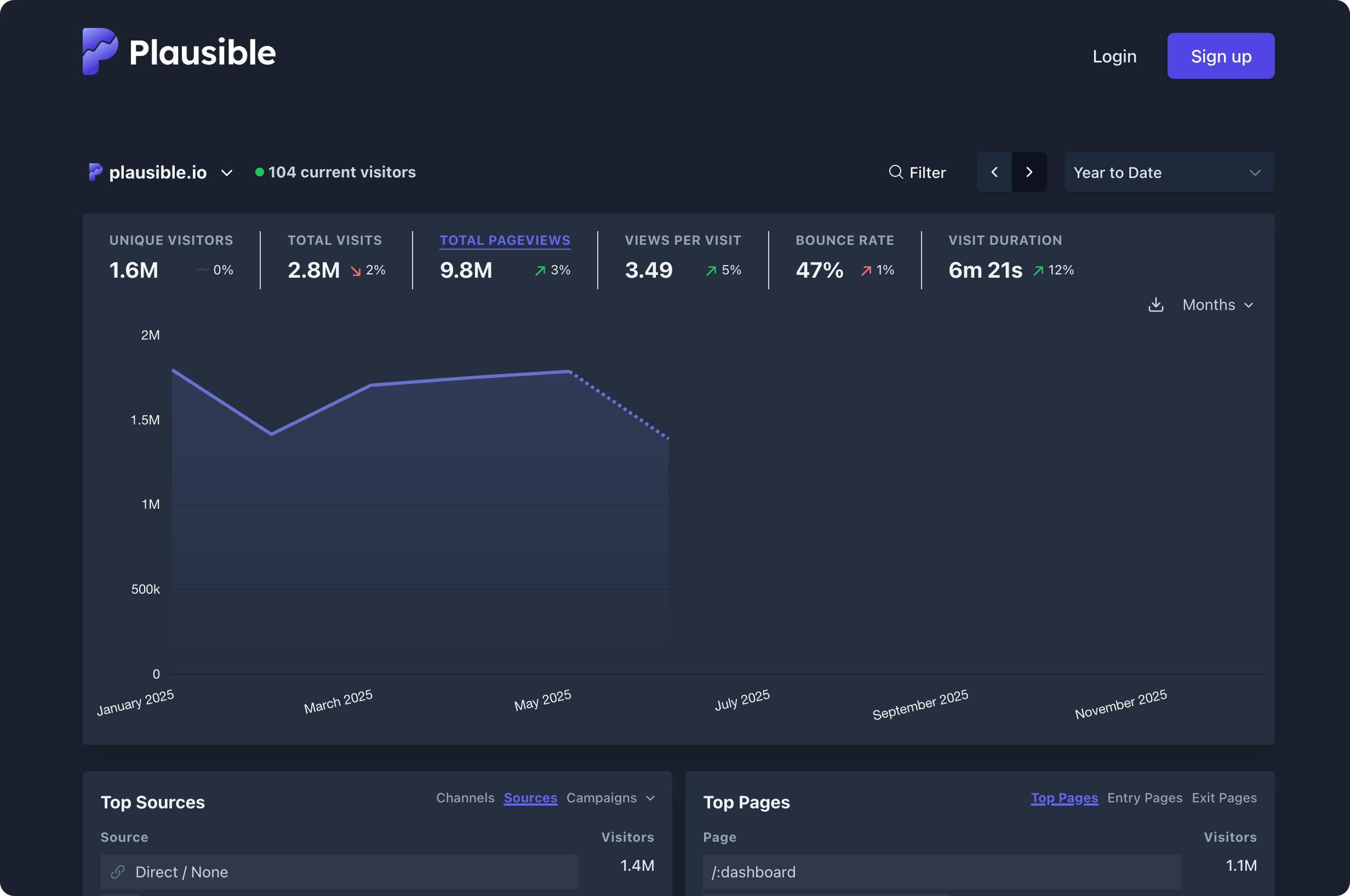
Plausible is a lightweight web analytics tool. It tracks pageviews, sources, and goals without cookies. It's made and hosted in the EU.
Best for: sites that need simple traffic stats. Plausible says itself that it's not the right fit if you need session replay, cohorts, or retention.
- Tracking script of about 2.5 KB
- No cookies
- Free self-hosted Community Edition, without funnels or revenue goals
- Cloud from $9/month for 10K pageviews; no free plan
Fathom
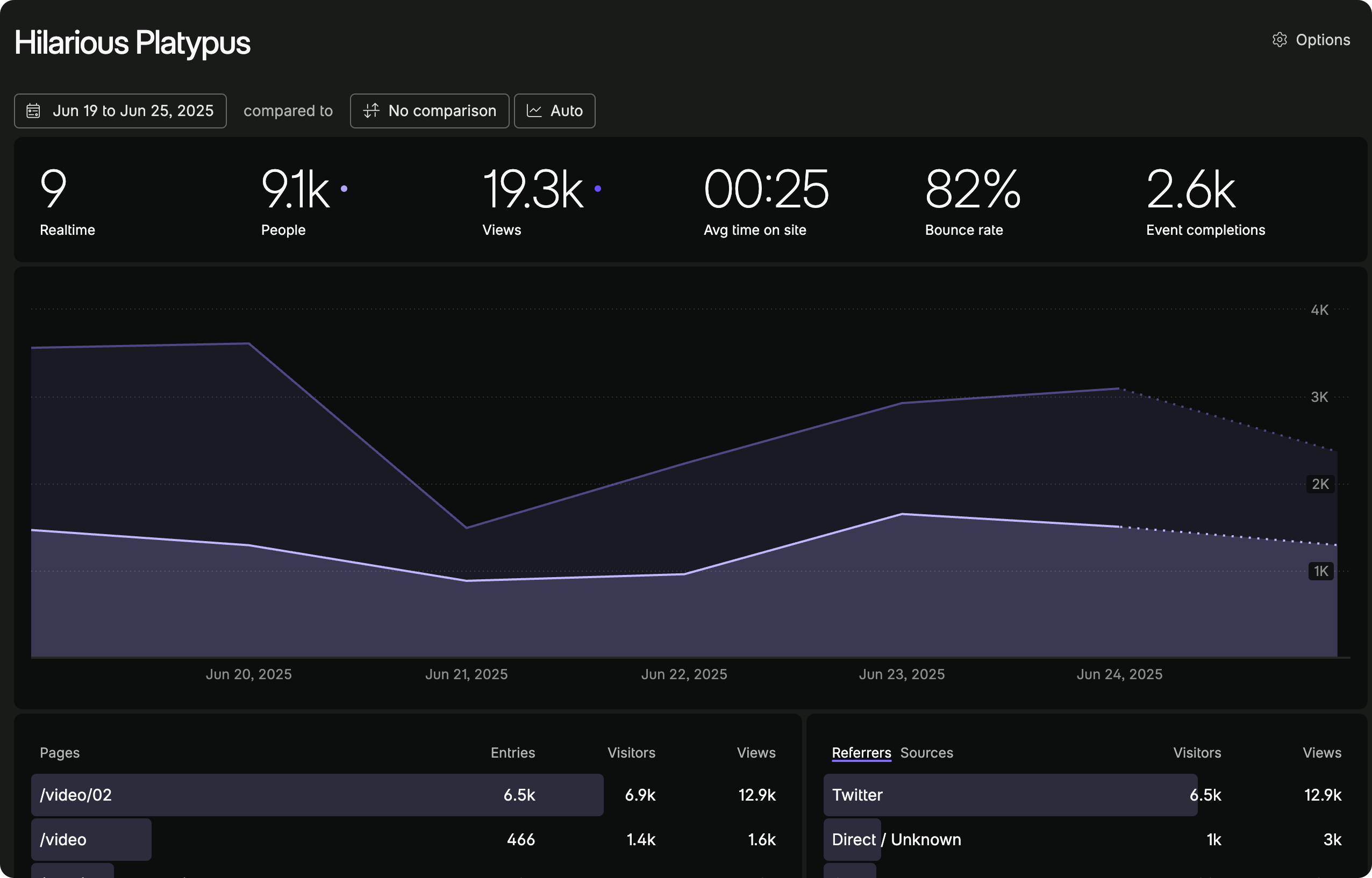
Fathom is a managed privacy analytics tool. It says it "doesn't use cookies." EU traffic is routed through European-owned infrastructure.
Best for: teams that want a fully managed tool and no servers to run.
- No cookies
- EU traffic on European-owned infrastructure
- No self-hosting
- From $15/month for 100K pageviews; the free trial needs a card
Simple Analytics
Simple Analytics is privacy-first web analytics from the Netherlands. It says it uses "no cookies" and collects no IP addresses. It pitches itself as a layer you run next to GA4, to count the visitors who reject consent.
Best for: teams that want simple numbers, or a cookieless layer next to GA4.
- No cookies and no fingerprinting, per its site
- An AI assistant to chat with your analytics
- A free plan for hobby sites (5 sites, 1 month of history, badge required)
- Paid plans from €20/month for 100K pageviews
Pirsch
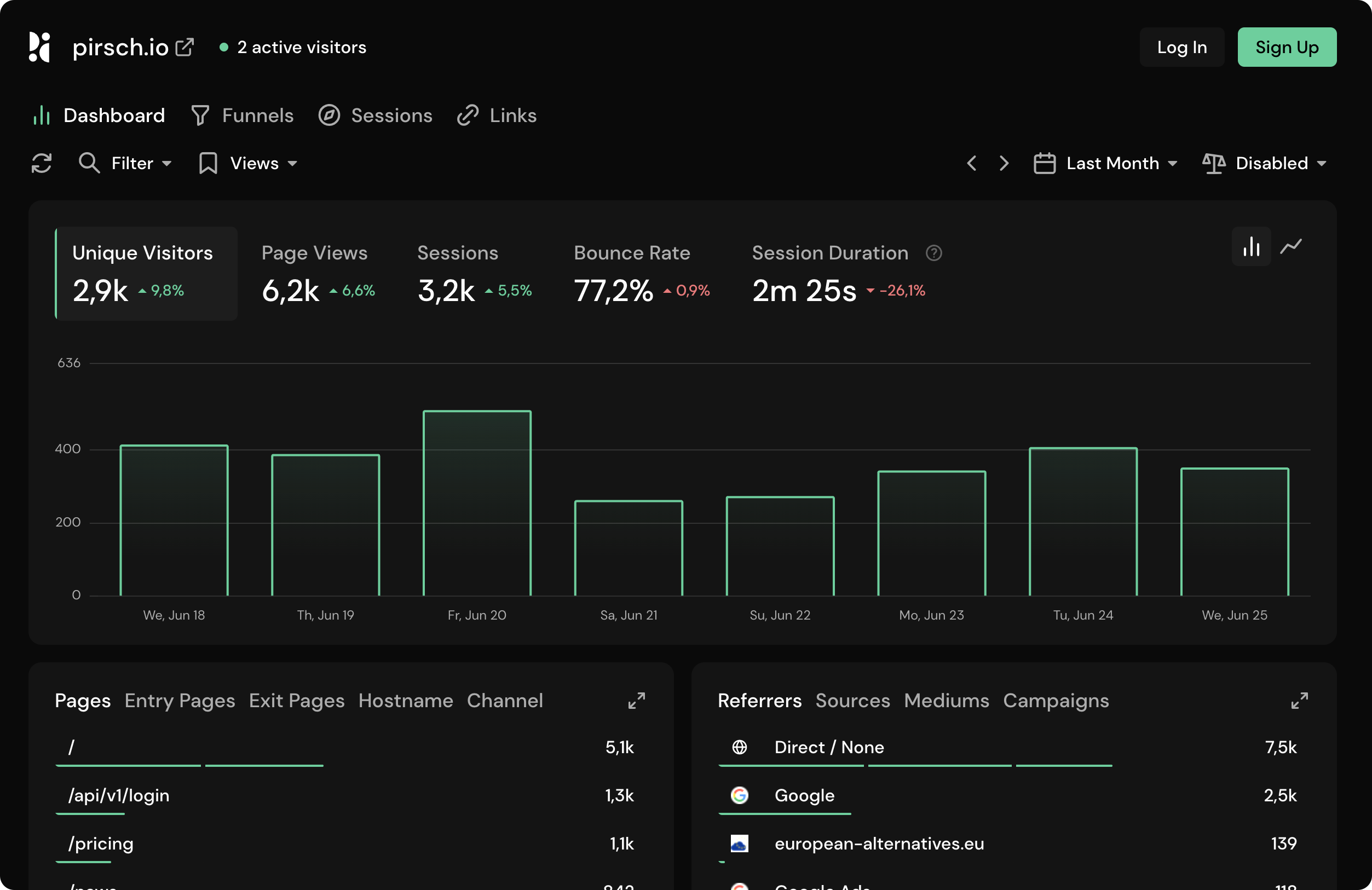
Pirsch is made and hosted in Germany. You can add its script, use a plugin, or send data from your backend through its API. The API option means ad blockers can't get in the way.
Best for: developers who want the choice of client-side or server-side tracking.
- No cookies
- Script, plugins, or server-side API
- Self-hosting only on Enterprise
- From $6/month for 10K pageviews; funnels are on the Plus plan
Cookieless analytics vs traditional analytics
Moving from a cookie-based tool like Google Analytics to a cookieless one changes more than privacy. It changes which data you get.
What you gain
Fuller visitor counts. Cookie-based tools miss people who decline consent or block cookies. A cookieless tool doesn't depend on a cookie, so declining cookies doesn't remove someone from your stats. (Ad blockers can still block some scripts. Server-side tracking avoids that.)
Often no cookie banner for analytics. Without cookies, many sites don't need a consent banner for analytics. But EU rules can cover scripts that read data from the device, not only cookies, and some countries have no exemption for analytics. Session replay needs consent everywhere, and other tools on your site may need a banner too. See Do you need a cookie banner? and check your setup with your own legal counsel.
Simpler cookie audits. No analytics cookies means fewer cookies to list, explain, and manage.
Lighter pages. Many cookieless tools use small scripts. Plausible's is about 2.5 KB.
Less exposure to browser changes. Your analytics doesn't break when a browser tightens its cookie rules.
What you lose
Long-term tracking of anonymous visitors. Without a lasting cookie, you can't easily follow the same anonymous visitor over weeks. In Pieowl, the visitor hash changes when the daily salt rotates. So if someone visits on Monday and comes back on Thursday without logging in, they count as two visitors.
This matters less than it sounds. Once someone signs up or logs in, you can identify them with your own user ID and follow them across visits.
Some Google Analytics features. GA's remarketing audiences and Google Ads links rely on cookies. If you need those, you'll need another approach.
Long attribution windows. Multi-touch attribution over many weeks is harder without a lasting ID. Pieowl still shows revenue by source, campaign, and referrer.
The bottom line
For most sites, cookieless analytics gives you a fuller count of visitors and, depending on your country, often drops the consent work for analytics. The tradeoff is weaker long-term tracking of anonymous visitors, which logged-in user IDs mostly make up for.
Getting started with cookieless analytics
Here's how to set up Pieowl. No cookies and no complex setup.
1. Add the tracking snippet
<script src="https://pieowl.com/pieowl.js" data-client-id="YOUR_CLIENT_ID" defer></script>2. Track custom events
window.pieowl('track', 'signup_button_clicked');

window.pieowl('track', 'order_placed', {
  orderId: 'ORD-20260216-001',
  currency: 'EUR',
});

// Track a purchase (amount in normal units)
window.pieowl('purchase', { id: 'ORD-20260216-001', amount: 49, currency: 'EUR' });
That's it. You're collecting analytics without cookies.
FAQ
What is cookieless analytics?
Cookieless analytics tracks website and app usage without storing cookies in the visitor's browser. It uses methods like server-side tracking, short-lived session IDs, and daily-rotating hashes instead. Because it sets no cookies, in many cases you don't need a consent banner for it. Privacy laws still apply to any personal data you collect.
Is cookieless analytics GDPR compliant?
Going cookieless makes GDPR easier, but it doesn't make you compliant by itself. GDPR covers all personal data, not just cookies. Pick a tool that collects as little as possible and tells you where data is stored. Pieowl is built for GDPR: no cookies and no stored IP addresses, with your data stored in the EU. Check your setup with your own legal counsel.
Do I still need a cookie banner with cookieless analytics?
Often not for the analytics itself, but it depends on your country. EU rules cover reading information from a device, not only cookies. France and the Netherlands have exemptions for simple audience measurement. Germany, Poland and Ireland have none. Session replay needs consent everywhere. You may also need a banner if other parts of your site use cookies, such as ads, chat widgets, or embedded videos. See Do you need a cookie banner?.
How accurate is cookieless analytics compared to Google Analytics?
For pageviews and visitors, it's often more complete. Cookie-based tools lose everyone who declines consent or blocks cookies. Where a cookieless tool can run without consent, those visitors stay in your numbers. Ad blockers can still block some scripts; server-side tracking avoids that. The tradeoff is weaker long-term tracking of anonymous visitors.
Can cookieless analytics track individual users?
Anonymous visits are tracked per day or per session. Once a user logs in, tools like Pieowl can link their activity to a profile using your own user ID. That gives you user-level funnels, retention, and journeys for logged-in users, with no cookie.
What is the best cookieless analytics platform?
Is Google Analytics cookieless?
No. GA4 uses first-party cookies by default. With Google's consent mode in its advanced setup, GA4 sends "cookieless pings" when a visitor declines, and Google uses them to model the missing data once you pass a data threshold. That's an estimate, not a count. A tool built without cookies counts those visits directly.
Can I use cookieless analytics with a self-hosted setup?
Yes, with some tools. Plausible's Community Edition can run on your own servers, and Pirsch offers self-hosting on its Enterprise plan. With self-hosting, your analytics data stays on servers you control. Pieowl has no self-hosted option; it runs in our EU cloud. See our guide on analytics and compliance.